







Bidirectional EV Charger


Bidirectional EV charger, what is it and why is it a good choice?
A bidirectional charging station charges in two directions. It charges your car the way any charging station does, and it can also send power back out of the car battery to run appliances in your house or to feed the grid. Your electric car becomes an extra power source for your household.
Two-way charging offers real financial benefits, especially if you have solar panels or a variable energy tariff. Below we explain how.
- Use your car as a power source
- Use your car as a battery for the solar energy you generate
- Lower your energy bill
Because bidirectional charging is still a young technology, only a limited number of cars support it. The charging stations have caught up faster than the cars have, so the car is usually what decides whether this works for you.
A variable energy tariff makes the case strongest. You charge the car when electricity is cheapest and use that same electricity in the house when prices climb, which means you effectively live on a low rate around the clock. With solar panels the logic is similar: surplus daytime energy goes into the car instead of straight onto the grid, and comes back out in the evening when the sun is gone.
Different ways of bidirectional charging
The term "bidirectional charging" covers several different setups. Here is what each one means.
V2H
V2H stands for vehicle-to-home and is the best known form of bidirectional charging. Power flows from your car into your house, so the car works as an extra battery. It is useful during a power cut and useful when electricity is expensive at that moment. Looking for a V2H charging station? Get in touch and we will tell you which combinations of car and charger currently work.
V2G
V2G stands for vehicle-to-grid: power from your car goes back to the electricity grid. V2G becomes financially interesting where feeding power back is paid at a variable rate, which is why it draws most attention in markets that are moving away from flat net metering. In the Netherlands, for example, net metering ends on 1 January 2027. Rules, tariffs and grid operator approval differ per country, so check what applies where you live. You can see our V2G ready models in the V2G section of this category.
V2L
Bidirectional charging also has a form that needs no charging station at all. V2L, or vehicle-to-load, turns your electric car into a power point for ordinary appliances through a plug adapter. You can run a laptop, a fridge, lights or power tools straight from the car. Typical output is around 2.4 to 3.6 kW, which is plenty for appliances but not enough to run a whole house.
Bidirectional EV chargers in our range
Our range in this category has grown from a single future-proof model to a full line-up, from V2G ready AC chargers to a DC charging station that handles V2H and V2G today. You can see all of them at the top of this page, with their specifications and current availability.
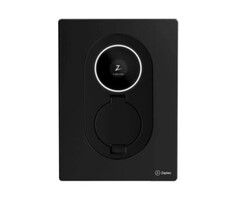
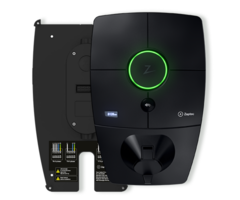
Broadly there are two routes. A V2G ready AC charger is the safe middle road: it charges your car normally today at up to 22 kW, and the hardware is built to support bidirectional charging once your car and your grid operator allow it. The Zaptec Go 2 and the Zaptec Pro sit in this group, as does the Peblar Business and the Ratio io6 Pro. A bidirectional DC charging station is the route for people who want two-way charging working now. It converts power itself instead of relying on the car's onboard charger, which is what makes real V2H possible, and it uses a CCS2 connector rather than Type 2.
Whichever route you take, check your car first. A charger that is ready for bidirectional charging cannot do anything if the vehicle does not support it, and support still varies per model and per build year.
Several of these models can be extended with dynamic load balancing so the charger takes your total household consumption into account and never trips the main fuse. The Zaptec Sense connects to the smart meter over Wi-Fi and adds exactly that.
Frequently asked questions
Is there a subsidy for a bidirectional charging station?
That depends entirely on where you live. Subsidies for home charging stations are national or even regional, they change from year to year, and in a number of countries there is currently nothing available for charging stations at all, only for the vehicles themselves. Check the scheme that applies in your own country before you count on it, and ask us if you are not sure what exists in your market.
How much does a bidirectional charger cost?
A V2G ready AC charger costs roughly what a comparable regular smart charger costs, because the hardware is largely the same. A bidirectional DC charging station is a different category and costs several times as much, since it contains its own power conversion. The current prices for every model are listed at the top of this page.
Which charging station can charge bidirectionally?
Every model in this category is either V2G ready or fully bidirectional today. The V2G ready AC chargers charge your car normally and are built to support two-way charging once your car and your grid operator allow it. The DC charging station in this category supports V2H and V2G now. The limiting factor is almost always the car, not the charger.
What is the difference between V2G and V2H?
The difference lies in where the energy from your car goes. Both rely on bidirectional charging, meaning the car can discharge as well as charge, but the purpose is different.
With V2G the car is connected to the public electricity grid. When the grid is under pressure, the car can feed electricity back into the system. That helps stabilise the grid and can pay the owner for the service.
With V2H the focus is your house. Instead of supporting the wider grid, the car supplies power directly to your home. That is useful during a power cut, or to cut costs when electricity is expensive. V2H systems are generally simpler to implement because they only interact with your home's internal electrical system.
In short: V2G supports the grid and may pay you for it, V2H supports your own household and makes you less dependent.
Can V2L power a house?
V2L, or vehicle-to-load, lets an electric car supply power to appliances through a standard outlet. It is handy when you need temporary power, for camping, outdoor work or a short outage. With a typical output of around 2.4 to 3.6 kW it easily runs a fridge, a laptop, lights or a coffee machine, but it is not a whole-house solution. For that you need V2H and a bidirectional charging station.
Is V2H worth it?
That depends on your situation, but for many households it adds real value. If power cuts are common where you live, V2H turns your car into a backup supply that keeps the fridge, the lights and the internet running, without you buying a separate home battery or generator. V2H is also attractive if your tariff varies through the day: charge when electricity is cheap, run the house on that energy when it is expensive.
The other side is that V2H needs a bidirectional charger, which costs more than a regular one, and it needs a car that supports it. Your home electrical installation may also need work. How much you save depends on local tariffs and local rules, and both differ per country.
Do Teslas have bidirectional charging?
Partly. The Cybertruck supports vehicle-to-home through Tesla Powershare. The 2026 Model Y Performance supports vehicle-to-load through the Tesla Outlet Adapter, at up to 2.4 kW. Most other Tesla models still do not support bidirectional charging, so check your own model and build year before you count on it.
Why buy a bidirectional EV charger
A bidirectional charging station turns your electric car into a home battery that stores the solar energy you would otherwise give away. That saves money, and it makes better use of energy you already generated. In markets where feeding power back is being paid less generously than it used to be, that shift matters more every year.
At Wallbox Discounter sustainability is one of our core values. We only stock products that help build a greener world, and we combine that with the best service we can give.