







Hybrid EV Charger
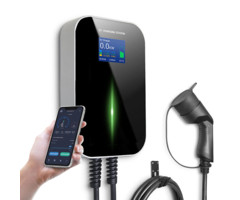
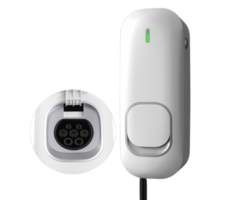
An affordable Hybrid EV Charger charges your plug-in hybrid three to four times faster than a standard household socket. At Wallbox Discounter, you will find models from Besen and Loady specifically designed for the onboard charger of a PHEV: single-phase, Plug & Charge ready and without complicated apps. You can order the charger separately or including installation at your home.
- Competitive pricing, largest online selection
- Free shipping on orders above €150
- Ordered before 15:00, shipped today
- Your charging specialist from the Netherlands
What exactly is a Hybrid EV Charger?
A Hybrid EV Charger is a charging station specifically designed for the lower charging capacity of a plug-in hybrid vehicle. The onboard charger of most PHEVs accepts a maximum of 3.7 kW, while some models support up to 7.4 kW. A Hybrid EV Charger is tailored to this requirement: single-phase, fixed charging output and automatic charging as soon as you connect the cable.
This keeps costs low. There is no need for expensive 3-phase technology if your vehicle cannot use that additional power anyway. At the same time, you benefit from the safety and convenience of a dedicated charging station instead of using a regular wall socket in your garage or carport.
Who is this charger intended for?
The Hybrid EV Charger is designed for drivers of plug-in hybrid vehicles with small to medium-sized batteries, typically ranging from 8 to 25 kWh. Examples include the Mitsubishi Outlander PHEV, Volvo XC40 T5 Twin Engine, Kia Niro PHEV, BMW 330e and Mercedes GLE 500e. These vehicles generally charge at 3.7 kW or, in some cases, 7.4 kW on AC power. A more powerful charging station therefore does not increase charging speed.
Planning to switch to a fully electric vehicle in the near future? Then it may be worth considering a 7.4 kW EV Charger or even a 3-phase charging station. These work perfectly with your current plug-in hybrid while also being ready for future EVs.
Which charging capacity should you choose for a plug-in hybrid?
The right choice depends on two factors: the technical capabilities of your vehicle and how long you expect to keep driving it. For most plug-in hybrids, 3.7 kW is more than sufficient. A 15 kWh battery can be fully charged in approximately four hours at this power level. Using a standard household socket, the same charging session often takes more than six hours.
Does your PHEV support 7.4 kW AC charging, as is the case with some newer models? Then charging times are roughly cut in half. The Besen 7.4 kW and Loady Pulse 7.4 kW require a 32A single-phase connection. Ask your installer whether your electrical installation can support this setup.
| Charging capacity | Suitable for | Charging time for a 15 kWh battery |
|---|---|---|
| 2.3 kW (household socket) | Emergency solution | More than 6 hours |
| 3.7 kW (single-phase, 16A) | Almost all PHEVs | Approximately 4 hours |
| 7.4 kW (single-phase, 32A) | PHEVs with a faster onboard charger | Approximately 2 hours |
Which models are available at Wallbox Discounter?
On this page you will find four Hybrid EV Chargers from Besen and Loady. All models operate on a single phase, feature a fixed 6-metre Type 2 charging cable and automatically start charging as soon as the vehicle is connected. No apps, charging cards or complicated settings required.
- Besen 3.7 kW Type 2, 6 metres
- Besen 7.4 kW with app, Type 2, 6 metres
- Loady Pulse 3.7 kW Type 2
- Loady Pulse 7.4 kW Type 2
Would you like to schedule charging sessions, monitor electricity consumption or control your charger using your smartphone? Then take a look at our smart EV chargers. These offer additional features and support 3-phase charging, making them suitable for future fully electric vehicles as well.
Advantages of having a dedicated charger for your plug-in hybrid
A Hybrid EV Charger offers several important advantages compared to charging from a standard household socket:
- Faster charging – approximately three to four times faster than a regular wall socket
- Dedicated electrical circuit with appropriate residual current protection, reducing the risk of overheating
- Safer for daily use, even in rain or freezing temperatures
- Suitable for charging with self-generated solar energy if you have solar panels installed
A Hybrid EV Charger is connected to a dedicated electrical circuit just like any other charging station. Depending on the model, the installer will use a Type A or Type B residual current device (RCD). This is one of the main reasons why a charging station is significantly safer than charging through a standard 10A household socket for extended periods.
Potential drawbacks to consider
A Hybrid EV Charger is intentionally kept simple and affordable. As a result, some advanced features found on more expensive chargers may be unavailable:
- Limited upgrade options, such as no 3-phase charging or load balancing support
- No app or charging statistics on the entry-level models
- Less suitable if you plan to switch to a fully electric vehicle with a faster onboard charger in the future
- No support for ISO 15118 Plug & Charge, as plug-in hybrids generally do not use this functionality. For fully electric vehicles, this technology allows the vehicle to automatically identify itself without requiring a charging card or app.
If you expect to keep driving a plug-in hybrid for many years, this is not an issue. However, if you are unsure what your next vehicle will be, a 3-phase charging station may be the more future-proof choice, as it will work with both your current PHEV and a future EV.
Frequently asked questions about Hybrid EV Chargers
Do I need a dedicated charger for a plug-in hybrid?
No. You can use any Type 2 charging station. However, since the onboard charger of most PHEVs is limited to 3.7 kW or 7.4 kW, a simple single-phase charging station is usually sufficient and more cost-effective.
Can I charge a fully electric vehicle with a Hybrid EV Charger later on?
Yes. A fully electric vehicle can also be charged using a 3.7 kW or 7.4 kW charger. However, charging speeds will be lower than with a 3-phase charging station. If you expect to switch to an EV within the next few years, we recommend choosing an 11 kW or 22 kW home EV charger from the start.
Do I need a separate charging cable?
All Hybrid EV Chargers on this page include a permanently attached 6-metre Type 2 charging cable. This means you do not need a separate charging cable. No need to store a cable in the boot and no risk of leaving it behind.
What if I need to charge while travelling?
For charging on the road, a mobile EV charger is a convenient solution to keep in your vehicle. It is particularly useful during holidays or overnight stays where no charging station is available.
Order your Hybrid EV Charger from Wallbox Discounter
Would you like to know how much time and additional safety a Hybrid EV Charger can provide every month? Then also take a look at our page about the total cost of a home EV charger. Need installation as well? We can also arrange professional installation at your home by a certified installer.
Our advisors understand the differences between the onboard chargers used in all major PHEV models and are happy to provide free and independent advice. Call us on 074-7002114, send an email to [email protected] or contact us via WhatsApp on +31 6 34797985. Ordered before 15:00? Your order will be shipped today.