







Mobile EV Charger type 1
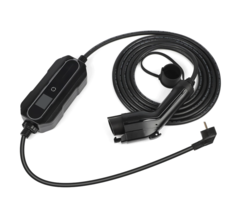
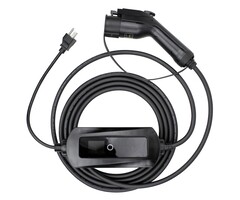
A Type 1 connection, also known as SAE J1772, is mainly found on older electric cars and plug-in hybrids. Many of these models originally came from the United States or Asia. If you drive one of these vehicles, you can charge it using a portable Type 1 EV charger connected to a suitable socket. Pay attention to the mains plug: the Schuko version is intended for European domestic sockets, while the NEMA version is designed for the North American market.
- Charge directly from a suitable socket without installing a fixed EV charger
- Adjustable current from 6 to 16 A
- Ordered before 15:00, dispatched today
Which cars have a Type 1 connection?
Type 2 became the European standard for AC charging during the 2010s. Vehicles with a Type 1 charging port continued to be sold for several years, however, and many are still on the road today. You can recognise a Type 1 connection by its five contact points, while Type 2 has seven.
- First-generation Mitsubishi Outlander PHEV
- First-generation Nissan Leaf, model years 2011 to 2017
- Opel Ampera and Chevrolet Volt
- Citroën C-Zero and Peugeot iOn
- Ford Focus Electric
Type 1 always charges on a single phase
A Type 1 connection only supports single-phase AC charging. The vehicle therefore never charges on three phases, even when your home has a 3-phase electrical connection. The amount of power the vehicle can accept depends on the model and its onboard charger. A Mitsubishi Outlander PHEV, for example, usually charges at approximately 3.7 kW. If your Nissan Leaf or Ford Focus Electric has a 6.6 kW onboard charger, you can only use that higher power through a suitable single-phase charging point rated at up to 32 A. With a portable Schuko charger, the charging power is generally limited to a maximum of 3.7 kW.
For regular charging above 3.7 kW, a fixed EV charger at home is the more sensible solution. Check whether the EV charger, electrical circuit and vehicle all support single-phase charging at 32 A.
Check the socket and electrical circuit
Depending on the model, these portable EV chargers can be set to a maximum of 16 A, which corresponds to a charging power of approximately 3.7 kW. An ordinary domestic socket is not automatically suitable for several hours of continuous load at 16 A. The socket must be earthed and in good technical condition. The wiring, contacts and protective devices must also be suitable for the load.
Set the current to 10 A when you are unsure about the socket or the wiring behind it. For regular charging, use a separate, correctly protected and professionally inspected circuit wherever possible. Other high-power appliances should not be used on the same circuit while the vehicle is charging.
An old, damaged or loosely connected socket can become very hot under prolonged load. This increases the risk of damage and fire. Have the connection inspected by a qualified electrician when you intend to charge the vehicle regularly through a Schuko socket.
Frequently asked questions about portable Type 1 EV chargers
Can I charge my Type 1 car at a public charging station?
Yes. At a public AC charging station with a Type 2 socket, you need a charging cable with a Type 2 plug on the charging-station side and a Type 1 plug on the vehicle side. The charging station remains Type 2 and your vehicle remains Type 1. Because Type 1 only supports single-phase charging, the vehicle’s onboard charger determines the maximum charging power.
Does an ISO 15118 requirement apply to this portable charger?
A portable EV charger with an integrated control and protection device in the cable normally operates in charging Mode 2. These so-called IC-CPD charging devices are covered in particular by IEC 62752. Fixed AC EV chargers generally operate in charging Mode 3, while DC fast-charging stations use charging Mode 4.
ISO 15118 requirements that apply to certain fixed or publicly accessible charging points therefore cannot automatically be applied to a portable Mode 2 charger. In addition, a vehicle with a Type 1 connection will generally not support modern Plug & Charge functions implemented through ISO 15118.
What is the difference between this and an ordinary Type 1 charging cable?
A portable Type 1 EV charger has a control and protection unit built into the cable. This unit communicates with the vehicle, sets the permitted charging current and monitors the charging process. This allows the charger to be connected to a suitable domestic socket.
An ordinary Type 1 charging cable does not have this portable control box. It is used between the vehicle and a fixed or public charging station. The EV charger or charging station then controls and protects the charging process.
How long does charging from a domestic socket take?
Charging can take anywhere from a few hours to a full night or longer. The charging time depends on the usable battery capacity, current state of charge, selected current and the vehicle’s maximum AC charging power. For a plug-in hybrid with a small battery, an evening or overnight charge is often sufficient.
At 10 A, the vehicle charges at approximately 2.3 kW. At 16 A, up to 3.7 kW is theoretically possible, provided that the socket, wiring and circuit are suitable for this continuous load.
Can I use the NEMA version in Europe?
The NEMA version is designed for North American sockets and electrical installations. Do not use it in Europe with a simple travel adapter. For European domestic sockets, you need the Schuko version. Always check the supported mains voltage of the charger before purchasing.
Can I use an extension lead?
Do not use an ordinary domestic extension lead or cable reel between the socket and the portable EV charger. Additional plug connections increase electrical resistance and therefore increase the risk of heat, voltage loss and damage. Choose a portable EV charger with a cable length that is sufficient for your situation.
Are you unsure which charging connection your vehicle has? Contact us for personal advice by calling +31 074-7002114 or through WhatsApp.