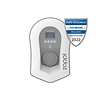
- The best wallbox to combine with pv-panels
- NEW: OCPP 1.6J backend communication; including for clearing loading sessions
- 3 year warranty
- Easy access and operating of the wallbox via the free Myenergi app
- Excellent service and complaint handling from Myenergi
- Cannot be used with a charging card
- Big size
Charge with your own cable using the Zappi 3 with socket
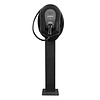
The myenergi Zappi 3 with socket is the untethered EV Charger in the new Zappi range. The front-facing Type 2 socket locks your cable in place while your car charges. You can choose a cable long enough to reach your parking spot, then put it away when you’re done to keep the wall clear. Founded in Lincolnshire in 2016, British brand myenergi makes EV Chargers, home batteries and devices that divert solar power to your hot water cylinder. You can control them all in one app.
Inside, it has the same features as the tethered Zappi 3 EV Charger, including a built-in MID meter, RFID reader, 4G and hardware for ISO 15118-20. It charges at up to 7.4 kW on a single-phase supply and up to 22 kW on a three-phase supply, so you can keep the same EV Charger if you upgrade your supply later.
- Automatic phase switching: charge from just 1.4 kW of surplus solar power, even on a three-phase supply.
- Two charging modes: in Smart mode, the Zappi 3 automatically uses surplus solar power, your charging schedules and your electricity tariff, including dynamic rates. In Fast mode, it starts charging immediately at full power.
- Lower charging costs with a dynamic tariff: the Zappi 3 uses your tariff to charge when electricity costs least.
- Boost Charge: hold the button for three seconds or tap Charge Now in the app to start a full charge immediately.
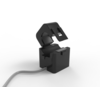
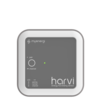
- Dynamic load balancing: the Zappi 3 uses only the power available after other appliances have been supplied. It comes with 3 CT clamps for wired measurement. A myenergi harvi can transmit the readings wirelessly.
- Built-in MID meter (Class B, 1%): records each kWh delivered so you can claim business charging expenses.
- RFID reader: one RFID tag is included. Register up to 127 tags per Zappi 3 to control who can charge.
- OCPP 1.6J (via the cloud) and a third-party API let you connect the Zappi 3 to a back office to view charging sessions, manage users and bill for the electricity supplied.
- Connectivity: Wi-Fi (2.4 GHz), Ethernet, 4G/LTE with your own nano-SIM and Bluetooth. Software updates are delivered automatically over the air.
- Free myenergi app: monitor and control your Zappi 3 remotely and see how much energy you generate, use and put into your car.
- V2G-ready: the hardware is designed for bidirectional charging under ISO 15118-20.
- Works with any inverter: the Zappi 3 measures surplus solar power itself, so you can use it across different systems.
- External control: a volt-free contact for a home energy management system (HEMS) or an inverter, for example.
- Built-in 6 mA DC residual current detection. An upstream residual current device is still required.
- LCD screen with multicolour status LED: see at a glance whether the Zappi 3 is charging, waiting for surplus solar power or following a schedule.
- IP65 and IK10: water- and impact-resistant, suitable for outdoor use and equipped with tamper detection.
- Equipped with a locking Type 2 socket. Put your cable away after charging to leave the wall clear.
- Three-year warranty, with an extension available.
Socket or tethered cable?
Both versions of the Zappi 3 charge at the same speed and offer the same features. The choice comes down to how you use the cable day to day.
| Your situation | Best choice |
|---|---|
| You want to keep the wall clear of a hanging cable. | Zappi 3 with socket |
| Your car is parked some distance from the EV Charger or sometimes on the other side of the driveway. | Zappi 3 with socket and a charging cable long enough to reach |
| You already have a Type 2 cable that you use at public charging points. | Zappi 3 with socket |
| You want to pick up the plug and start charging as soon as you get home. | Zappi 3 EV Charger with a 6.5 m tethered cable |
Which cable do you need for the Zappi 3 with socket?
The socket takes a separate Type 2 cable, just like the one you use at a public AC charging point. Choose a cable that matches your car’s AC charging capability.
- If your car accepts 22 kW AC, choose a 32 A three-phase cable.
- If your car accepts up to 11 kW on three phases, a 16 A three-phase cable is sufficient.
- For 7.4 kW single-phase charging, choose a 32 A cable to get the full charging power.
Check your vehicle manufacturer’s specifications for the maximum AC charging power. Choose a length that reaches comfortably from the EV Charger to your car’s charging port. Browse our Type 2 charging cables in lengths from 3 to 20 metres.
What does the Zappi 3 with socket add over the V2.1?
Familiar with the Zappi V2.1 with socket? The table shows what has changed in the new generation.
| Feature | Zappi V2.1 22 kW with socket | Zappi 3 with socket |
|---|---|---|
| MID meter | No | Yes, MID Class B (1%) |
| ISO 15118-20 | No | Yes, hardware included |
| RFID reader | No | Yes (13.56 MHz, Mifare) |
| Connectivity | Wi-Fi and Ethernet | Wi-Fi, Ethernet, 4G (LTE) and Bluetooth |
| Charging power | 22 kW on three phases | 7.4 kW single-phase or 22 kW three-phase |
| Weight | 3.3 kg | 3.7 kg |
| Enclosure | ABS | Polycarbonate (PC) |
Claiming home charging costs with the MID meter
The Zappi 3 with socket has a built-in MID meter certified to EN 50470, Class B. It measures exactly how many kilowatt-hours go into your car during each session. You can use these readings in two ways.
- In the Netherlands only, you can register your EV Charger with an ERE registration service. It registers eligible home charging on your behalf under the Dutch emission reduction unit (ERE) scheme and pays you your share of the proceeds. The scheme covers both private and business drivers.
- If you charge a company car at home, you can claim your charging costs from your employer using the same MID readings.
For Dutch ERE payments, the meter must be built into the EV Charger. Adding a separate meter to the distribution board does not qualify the charger for the scheme. That is why we recommend a built-in MID meter for most home charging setups. Compare other EV Chargers with a MID meter.
Smart charging with solar power and off-peak rates
Three wired CT clamps on your incoming supply, one per phase, provide the readings the Zappi 3 uses to track available solar power. If the distribution board is some distance away, you can send the readings wirelessly using a Myenergi harvi. To see solar generation separately in the app, you will usually need three additional CT clamps. In Smart mode, the Zappi 3 uses the readings to charge with surplus solar power. It also takes your schedules and electricity tariff into account, including dynamic rates. Automatic switching between one and three phases lets it start charging with just 1.4 kW of surplus power, regardless of your inverter’s make or model.
Select Fast for immediate charging at full power. To start charging straight away in Smart mode, hold the button on the EV Charger for three seconds or tap Charge Now in the app.
The same CT clamps enable dynamic load balancing. The EV Charger monitors your household consumption and uses only the remaining capacity, helping to protect the main fuse from overload.
ISO 15118-20 and bidirectional charging
ISO 15118-20 is the standard that lets a vehicle and an EV Charger communicate about features such as exporting power. The Zappi 3 with socket already has the hardware for bidirectional charging. Exporting power from your car to your home or the grid is not yet available. It requires myenergi software and a compatible vehicle. No software release date has been announced. If you want to export power now, explore our bidirectional EV Chargers.
The same standard also enables Plug & Charge. A compatible vehicle is recognised automatically and charging starts without a card or app. This feature is not active at delivery. Availability depends on the software, your vehicle and your charging service.
From 1 January 2027, the EU’s AFIR regulation introduces new ISO 15118-20 requirements for charging points. To see what this means for a home installation, read our article on ISO 15118-20 requirements for home EV Chargers.
RFID and connectivity
The RFID reader (13.56 MHz, Mifare) lets you restrict charging on your driveway to registered tag holders. One tag is included, and the EV Charger can store up to 127. It connects to the internet via Wi-Fi (2.4 GHz only), Ethernet or 4G and also supports Bluetooth. For 4G, you need your own nano-SIM. Smart charging itself requires no subscription. OCPP 1.6J, the open protocol for remote management, lets you connect a back office that logs sessions, manages users and bills for the electricity delivered. Myenergi installs software updates over the air.
What’s in the box?
- Myenergi Zappi 3 EV Charger with locking Type 2 socket (ZAPPI-4AP22UB-T)
- 3 CT clamps for solar charging control and load balancing, one per phase
- 1 RFID tag
- Charging cable sold separately. Choose the length that suits your car.
The three-year warranty can be extended to five years.
Installing the Zappi 3 with socket
Mount the Zappi 3 indoors or outdoors on a wall or a compatible mounting post (ZAPPI-PEDESTAL). The IP65 enclosure protects against dust and water jets, and its IK10 rating indicates impact resistance. Push-in terminals accept flexible conductors up to 6 mm² or solid conductors up to 10 mm², with cable entry at the rear or bottom. The Installer Assistant app supports commissioning. Your installer can also contact myenergi’s technical support team in the Netherlands.
The charging current varies between 6 and 32 A per phase. For the installation described here, the installer sizes the circuit for 32 A per phase with overcurrent protection of at least 40 A. Surge protection is fitted separately if required. If the distribution board is full, the installer adds an extension enclosure.
The built-in residual current protection detects 30 mA AC and 6 mA DC. Your installer determines which additional residual current device is required in the distribution board. Have a qualified professional make the connection, as mistakes in the board can have serious consequences. If you do not have an installer, we can arrange installation in the Netherlands and Flanders, Belgium.
Installing the 22 kW Myenergi Zappi 3
Have the Zappi 3 installed by a qualified EV Charger installer. Myenergi specifies that only qualified electrical installers may fit the Zappi 3. Your installer commissions it via Bluetooth using the myenergi Installer Assistant app and can access technical support from the Netherlands. Here is what to take into account when planning the installation:
- The Zappi 3 has an adjustable current of up to 32 A. For the Dutch installation described here, the circuit is sized for 32 A per phase, with overcurrent protection of at least 40 A for single-phase or 40 A per phase for three-phase.
- Supply cable with a conductor cross-section of 4 to 10 mm².
- The Dutch installation described here uses an upstream 30 mA Type A residual current device in accordance with NEN 1010. For future V2G use, choose a device suitable for power flow in both directions.
- Surge protection is not built into the Zappi 3. The installer fits it in the distribution board where required.
- Choose your connection in advance: Wi-Fi is preferred (2.4 GHz only), with Ethernet (Cat5e, up to 100 m) or 4G/LTE with your own nano-SIM as alternatives.
- The CT clamps go on the incoming supply, one per phase. If the distribution board is some distance away, a myenergi harvi can transmit the readings wirelessly.
- Mount indoors or outdoors on a wall or a Zappi mounting post, preferably out of direct sunlight.
- Check the space available in your distribution board. An extension enclosure is often needed.
We recommend having your EV Charger installed by a qualified professional. Installation calls for specialist knowledge, and mistakes can have serious consequences. Qualified installers have completed relevant training, often including the manufacturer’s own course. To find out what it would cost to install your 22 kW Myenergi Zappi 3 EV Charger, contact us for a no-obligation quote.
If you are planning the installation at home, discuss the following points with your qualified installer. The cable designations and examples refer to the Dutch installation described here.
The example specifies an RCBO with a B-curve overcurrent characteristic with a current rating below the main supply protection rating. You also need the appropriate supply cable. The Dutch example for this 22 kW EV Charger uses 5 × 6 mm² YMVK cable indoors or in conduit, or 4 × 6 mm² YMVK-as underground cable outdoors. There are two ways to connect the meters for dynamic load balancing and solar monitoring. A Myenergi harvi can transmit readings to the Zappi by radio over a distance of up to 15 m, independently of Wi-Fi. For longer distances or where wireless transmission is unsuitable, use a data cable. To see solar generation separately in the myenergi app, you need three additional myenergi CT clamps. Connect them using a second harvi or an additional data cable to the distribution board. For distances over 15 m, this setup uses two data cables when both measurements are required.
Is there enough room in your distribution board? The RCBO used in this example takes up four modules, so an extension enclosure is often required.
For the installation instructions for this EV Charger, see the manuals below.
Installation costs for the Myenergi Zappi 3 with socket
Installation costs vary by site, particularly when a harvi or data cabling is needed. Typical charges for installation by our team in the Netherlands are shown below, including VAT.
- Basic installation: €399
- Three-phase RCBO, including installation: €145.50
- YMVK-as 4 × 6 mm² cable per metre, installed: €10.95
- Cat 5 UTP cable per metre, including fitted connectors and installation: €5.11
- Configure load balancing via CT clamps or an external Modbus kWh meter: €199
Other common costs when installing a Myenergi Zappi include:
- Standard 110 × 220 extension enclosure, installed: €110.11
- Install a harvi for solar monitoring: €45.53
- Run an additional data/UTP cable: €55.00
- Additional Cat 5 UTP cable per metre, including fitted connectors and installation: €5.11
Other costs may apply depending on the site, for example if the EV Charger is installed on a mounting post. A mounting post often needs a concrete footing. You can find the full list of installation costs here on our website.
To book installation with us, add the basic installation to your basket. Any additional work and materials are billed at their actual cost.
Frequently asked questions about the Zappi 3 with socket
Does the Zappi 3 with socket come with a charging cable?
No. The socket version uses a separate Type 2 charging cable. For 22 kW charging, choose a 32 A three-phase cable. For up to 11 kW on three phases, a 16 A three-phase cable is sufficient. For 7.4 kW single-phase charging, choose a 32 A cable.
Does the Zappi 3 with socket meet the metering requirement for Dutch ERE payments?
Yes. It has the built-in MID meter required for the ERE scheme, which applies only in the Netherlands. The meter must be inside the EV Charger itself. Register your EV Charger with an ERE registration service to participate.
How does the Zappi 3 with socket differ from the V2.1 with socket?
Compared with the V2.1 with socket, the Zappi 3 adds a MID meter, an RFID reader, 4G, Bluetooth and hardware for ISO 15118-20.
Can the Zappi 3 with socket charge bidirectionally yet?
Not yet. The hardware is designed for it, but exporting power requires software from myenergi and a compatible vehicle. No release date has been announced.
Can I connect the Zappi 3 with socket to a single-phase supply?
Yes. It charges at up to 7.4 kW on a single-phase supply. If you upgrade to three phases later, the same EV Charger can deliver up to 22 kW.
Order the Zappi 3 EV Charger with socket from Wallbox Discounter
Looking for a tidy wall-mounted EV Charger with the hardware for future bidirectional charging and a built-in meter for the ERE scheme in the Netherlands? Choose the Zappi 3 with socket and the Type 2 cable that fits your car. If you’re unsure which cable or charging power you need, call +31 74 700 2114 or send a WhatsApp message to +31 6 34797985. Explore more models on our Zappi page.
Want to know more about the 22 kW Myenergi Zappi 3 EV Charger?
– Installation and user manual (in Dutch)
– Data sheet (in Dutch)
– Help centre: support.myenergi.com
Download the free myenergi app here: